
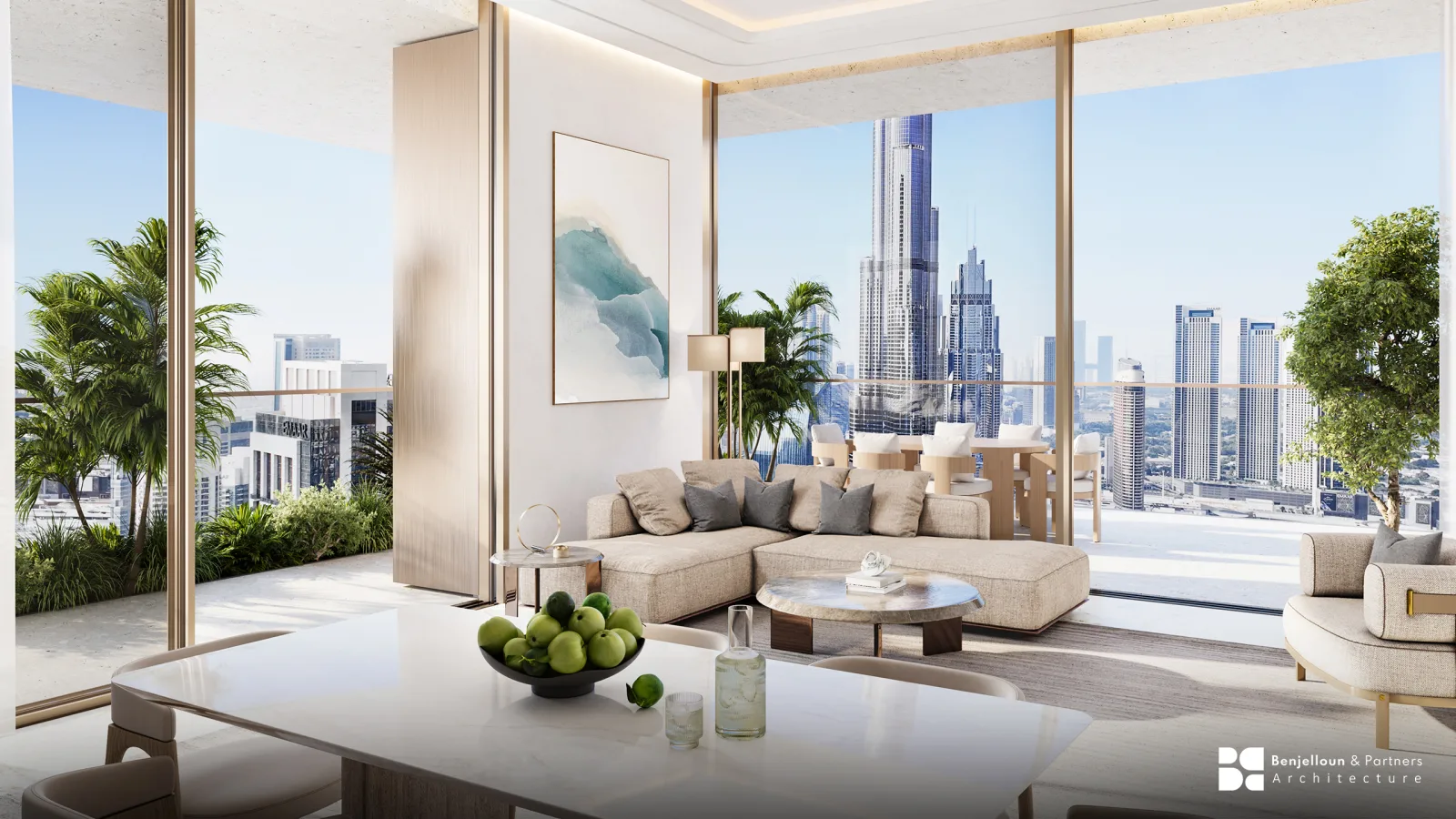
A branded residence is a residential building developed, marketed and usually operated under the name of an established brand — most often a hotel operator, sometimes a fashion, automotive or luxury goods house. The buyer purchases a home; they also purchase an association, a service standard and, in many cases, an operator.
The commercial logic is widely understood. What is discussed less is what the format demands architecturally, and why branded schemes are among the more constrained buildings a practice can be asked to design.
The two families
Hospitality-branded
The most established model. A hotel operator lends its name and, typically, its operating platform to a residential building — sometimes adjacent to or above a hotel, sometimes standalone. Residents gain access to hotel-standard services: concierge, housekeeping, maintenance, food and beverage, spa and leisure facilities.
The brand brings a defined service model, and the architecture must accommodate it. Back-of-house provision, service circulation separated from resident circulation, and amenity areas sized to operator standards are not optional extras — they are the conditions of the brand agreement.
Fairmont Residences Solara Tower in Downtown Dubai sits in this family, as does Waldorf Astoria among our work.
Non-hospitality branded
A newer and faster-growing category in which a fashion, automotive or design house lends its identity. Here the brand contribution is weighted towards design language, interior character and lifestyle association rather than an operating platform, though service is usually still provided by a third-party operator.
Our portfolio includes work in this category — Aston Martin, Missoni and Cartier Residence among them — where the architectural problem is different: the brand has a strong visual identity developed for products rather than buildings, and translating it into architecture without producing pastiche is the central design challenge.
What the brand actually governs
Clients new to the model often assume the brand is essentially a name applied at marketing stage. In practice a brand agreement typically reaches into:
- Design standards — dimensional minimums for rooms, corridors, lobbies and amenity spaces
- Amenity provision — which facilities must exist, and at what scale relative to unit count
- Operational planning — back-of-house, service lifts, staff circulation, waste and delivery routes
- Material and finish specification — often to a defined standard or approved schedule
- Approval rights — the brand reviews and signs off design at defined stages
That last point has the greatest programme consequence. A branded scheme carries an additional approval party, with its own review cycles, running in parallel to the client and the authorities. Design management on a branded project is materially more complex for this reason, and it is why we treat design management as a discipline rather than an administrative function.
What the format demands of the architecture
Two buildings in one. A branded residence must work as a home and as a serviced environment. The resident experience should feel private and residential; the service operation behind it should be invisible and efficient. Reconciling those is a planning problem before it is an aesthetic one.
Amenity that earns its area. Amenity space is unsellable area that carries the brand promise. It must be generous enough to justify the premium and disciplined enough not to erode yield.
Identity without imitation. The architecture should be legible as belonging to the brand without becoming a literal transcription of it. This is most acute with non-hospitality brands whose identity was developed for objects at a very different scale.
Durability of the association. Brand agreements have terms. A building whose architecture depends entirely on one brand's visual language is exposed if that association ends. The more robust approach is architecture that stands on its own terms, with brand expression concentrated where it can be renewed.
Why developers use the model
- Price premium. Branded schemes typically achieve a premium over comparable unbranded stock in the same location
- Sales velocity. An established brand reduces perceived risk for off-plan buyers, particularly international ones
- Operational credibility. Buyers acquire a known service standard rather than an untested management company
- Resale and rental positioning. The association persists into the secondary market
Published market research on branded-residence premiums varies considerably by source, market and period, and figures quoted for one market rarely transfer to another. The premium is better understood structurally than numerically: it reflects the brand association together with the service infrastructure that association obliges, and it therefore varies with the operator, the tier and the depth of the service model.
Common misconceptions
"The brand designs the building"
Rarely. The brand sets standards and approves; the architect designs. On a hospitality-branded scheme the operator's standards constrain the design considerably, but the architecture remains the architect's work.
"Branded means luxury"
Branded residences exist across several tiers. The defining characteristic is the brand association and the service model, not the price point — though in Dubai the format is heavily weighted towards the upper end.
"The premium is purely the name"
A significant part of it is the service infrastructure the name obliges — staffing, amenity, back-of-house — which has real capital and operating cost behind it.
"Any tower can be rebranded"
Retrofitting a brand onto a building not planned for it is difficult, because the constraints are spatial. Service circulation and back-of-house cannot easily be inserted after the fact.
Designing one well
The branded residences that succeed tend to share three characteristics: the service model was planned from the first massing study rather than accommodated later; amenity was sized against the operator's requirement rather than a marketing aspiration; and the brand is present in the experience of the building rather than applied to its surface.
Branded residences are usually towers, and are usually operated. Designing high-rise residential towers in Dubai covers the building type, and hospitality architecture in the UAE covers what an operator asks of a design team.
You can see how the typology sits within our wider portfolio in selected work, and how we structure the design and coordination of schemes with multiple approval parties across our capabilities. If you are considering a branded scheme, start a conversation.