
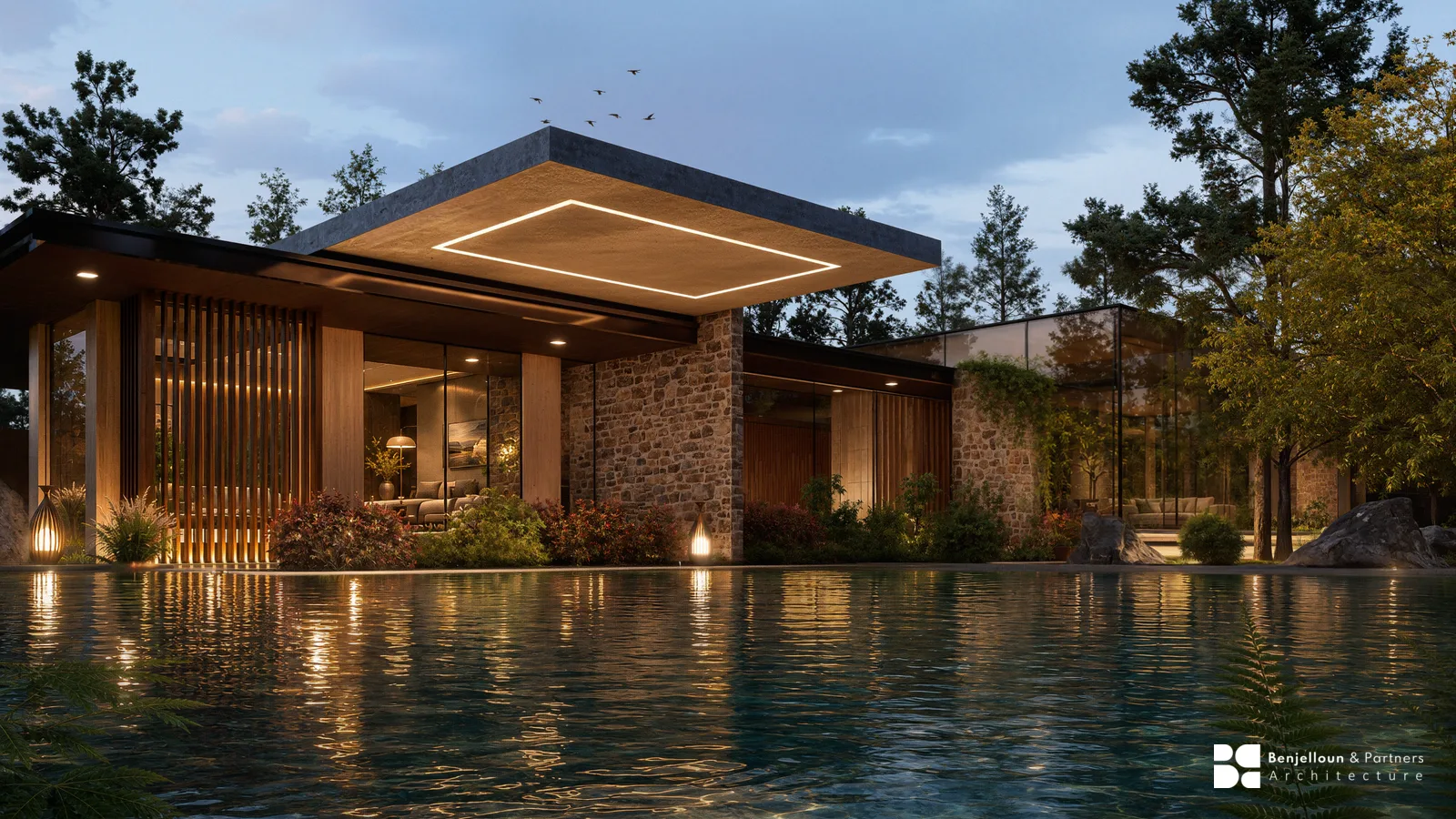
The cost to build a villa in Dubai is decided by six cost headings, not by a rate per square foot: the plot and the ground, the structure, the envelope, the fit-out, the services and the external works, with professional and authority fees beside them. Which of those headings your ambition lives in, and when each is decided, matters more than any figure quoted before a plot and a brief exist.
Key points
- There is no single price for a villa in Dubai; two houses of the same area on neighbouring plots can differ widely.
- Specification is the largest lever, complexity the second, the plot's own conditions the third.
- Most of the cost is committed by the end of concept design, long before a contractor is on site.
- Professional fees, authority charges, surveys and community review fees sit outside the construction figure.
What does it cost to build a villa in Dubai?
There is no single price for building a villa in Dubai, and any practice that quotes one before seeing the plot is guessing. What a villa costs is decided by a small number of things: the plot and what the community and the authority will allow on it, the size and complexity of the house you actually want, the specification of everything a buyer can see and touch, and the ground the house stands on.
Those four are not equal. Two villas of identical floor area, designed by the same practice on neighbouring plots, can differ in cost by a wide margin because of specification and site conditions alone. This is why a rate per square foot is the least useful number a client can carry into an appointment, and why a budget assembled from headings, with each heading owned by a decision, survives contact with a contractor while a single figure does not.
The useful question is not "what does it cost" but "what is this house going to be made of, who is going to decide that, and when". A budget is a series of decisions with prices attached. This article sets out the headings those decisions fall under, which ones move the total most, and the point at which the money is effectively committed.
One preliminary: the numbers in a villa budget belong to the project, not to the industry. Procurement prices, contractor rates and specification costs move, and they move differently for a plot in an established community than for a new one. Treat any figure you are given without a plot, a brief and a specification as an estimate of nothing in particular, including any you read on a website, ours included.
Which cost headings make up a villa budget?
A villa budget that can be managed is built from headings a contractor can price separately. Six of them do most of the work.
- The plot and the ground. The plot is bought, not built, but everything about it is a construction cost: how much excavation the levels demand, whether the water table requires dewatering, how far the house sits from the connection points for power, water, sewerage and telecoms, and whether the community's own rules require boundary treatment, landscaping or an external appearance more expensive than the one you would freely choose.
- The structure. Frame, slabs, foundations and the roof, driven by span, storey count and how much of the façade is glass. A villa with a long clear span over a living room and a villa of the same area divided by walls are not the same building, whatever their areas add up to.
- The envelope. Walls, roof build-up, glazing, shading and insulation. In Dubai's climate the envelope is a running cost as much as a capital one, and it is the one heading where spending more usually reduces expenditure elsewhere. Designing for heat sets out the trade.
- The fit-out. Kitchens, bathrooms, joinery, stone, floor and wall finishes, lighting. This is the heading with the widest range and the least relation to floor area, because its cost scales with specification rather than with size.
- The services. Mechanical, electrical, plumbing, controls and the smart systems a client now expects. On a villa the mechanical design is not a detail appended to the architecture; it needs plant space, risers and ceiling voids found in the planning.
- The external works. Pool, landscaping, boundary walls, driveway, pergolas, external lighting and pool plant. Frequently left out of a budget at the beginning, and the reason a project appears to overrun at the end.
What moves the cost of a Dubai villa most?
Specification is the largest single lever, and the one clients underrate because it does not look like a design decision. Two villas can carry the same plan and the same envelope and differ substantially in cost on the strength of kitchens, bathrooms, stone and joinery. If a budget has to move, it moves here first, and it moves most cheaply if the change is made before the specification is drawn rather than after it is tendered.
Complexity is the second lever, and it is the one an architect controls. A plan with a small number of well-proportioned rooms costs less to build than the same area cut into many small ones, because every partition, door, threshold and junction costs money to build and more money to get right. Curves, cantilevers, long spans, double-height volumes and bathrooms that are not stacked over one another are all legible in a price.
The third is the plot's own conditions: ground, levels, access and the connection distances to services. A difficult plot is not a design problem that a clever drawing solves; it is a cost.
The fourth is the community and the authority. Some communities within Dubai publish design requirements of their own, on top of the permitting authority's, and a submission route with more parties in it takes longer. Programme has a price attached, and when the delay came from design decisions the price is usually carried by the client rather than the contractor.
The fifth is timing. A specification finalised before tender is priced once. The same specification revised during construction is priced, re-priced and paid for twice, with the second payment carrying no competition.
When is a villa budget actually committed?
Clients tend to imagine that a budget is spent during construction, when the payments are made. In practice most of a villa's cost is committed long before a contractor arrives: by the end of concept design the shape of the spend is largely fixed, and by the end of technical design it is close to fixed in detail.
The practical consequence is that the moment to test a budget is at concept stage, when the plan can still change cheaply, and not at tender, when the only remaining lever is a contractor's margin. A concept tested against a cost plan, even an approximate one built from headings rather than rates, tells a client which of the six headings the ambition is actually living in.
The second consequence concerns approval. The design has to pass the permitting authority, which across much of the emirate is Dubai Municipality, and where the plot sits inside a master development, the community's design review as well. A scheme that passes both and then proves unaffordable is not a saving; it is the same project, approached twice. How design approvals work in Dubai sets out what the route involves.
The third is the tender. A complete tender package, with drawings, specification, a schedule of finishes and a clear scope of what is and is not included, produces comparable prices. An incomplete one produces a low price and a sequence of variations, which is the most expensive way a villa can be built. When you compare contractors, compare what each has excluded.
What does an architect's appointment cost, and what does it save?
An architect's fee is normally a percentage of the construction value, or a lump sum fixed against a defined scope. Either way it is a line in the project budget, and it sits alongside the other professional appointments: structural, mechanical and electrical engineering, cost consultancy, and whatever approvals the plot requires.
The honest way to read that line is not as a percentage to be negotiated down, but as the cost of the decisions that determine everything else. A practice that reads the plot, tests the brief against the budget and resolves the specification early is doing the work that prevents variations later. A low fee against a scope that has not been written down closely is the purchase of a decision that will be made later, by someone else, at a worse moment.
Fees are structured against a defined scope of stages, which is why proposals are difficult to compare: two numbers that look far apart are often not the same service. The stages, and what each one settles, are set out in architect fees in Dubai, and the appointment itself in whether you need an architect for a villa.
What a fee does not include matters as much. Authority submission fees, community review charges, surveys, soil investigation and specialist consultants are usually separate appointments or disbursements, and a budget built without them is short before it begins.
How should you brief a villa project without a rate card?
The most useful thing a client can bring to a first meeting is not a budget figure but a set of limits and priorities. From those, a cost plan can be built and tested, and the test will be worth something because it is attached to a plot and a brief.
- The plot: title, dimensions, levels, any surveys already done, and the community's design requirements if the plot sits inside one. A plot with an awkward level or a distant connection point changes the budget before a line is drawn.
- The brief on one page: how many bedrooms, what the ground floor has to do, whether there is a pool, staff accommodation, a majlis or a home office, and what the house must not compromise on. Not a wish list but a ranking; the second and third priorities are what a cost plan negotiates with.
- The programme: when you want to be on site, and what depends on that date. A villa built to a fixed family deadline is a different procurement from one with time to tender properly.
- The limits: the construction budget you are working to, and whether the fit-out, the external works and the professional fees sit inside it or beside it. Many budgets are set against the structure and envelope alone without saying so, and the gap surfaces later as a surprise.
What will not help is a rate per square foot taken from another project. Ask instead for the headings to be priced against your plot and your brief, and expect the answer to be a range with the assumptions written down. Villa or tower explains why a house and a tower are budgeted so differently, and our services set out how a villa appointment is structured. To test a villa budget against a real plot, get in touch.